
John Stezaker

John Stezaker, Raft, 2025.
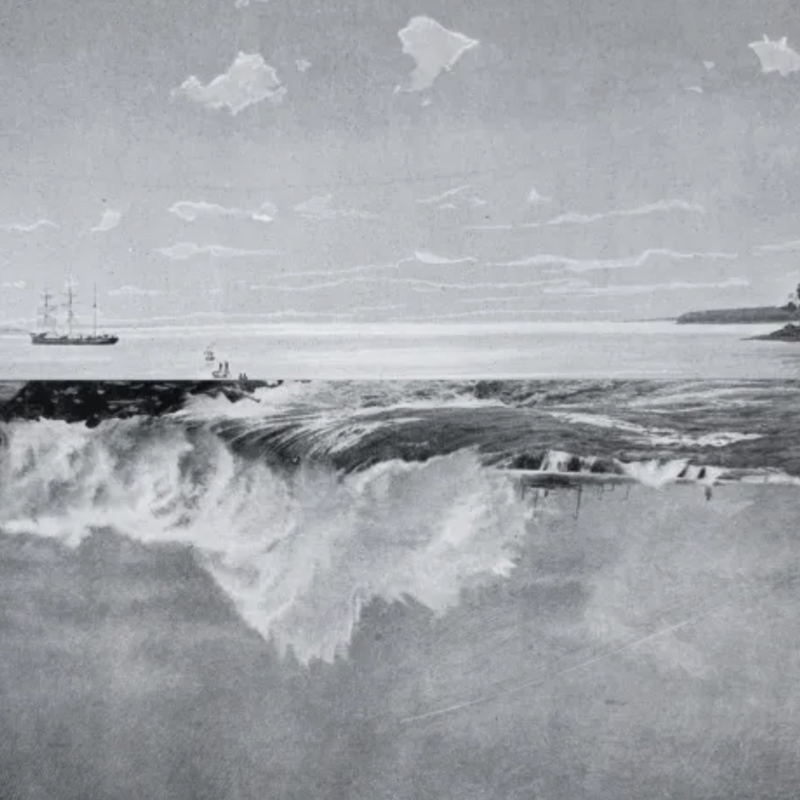
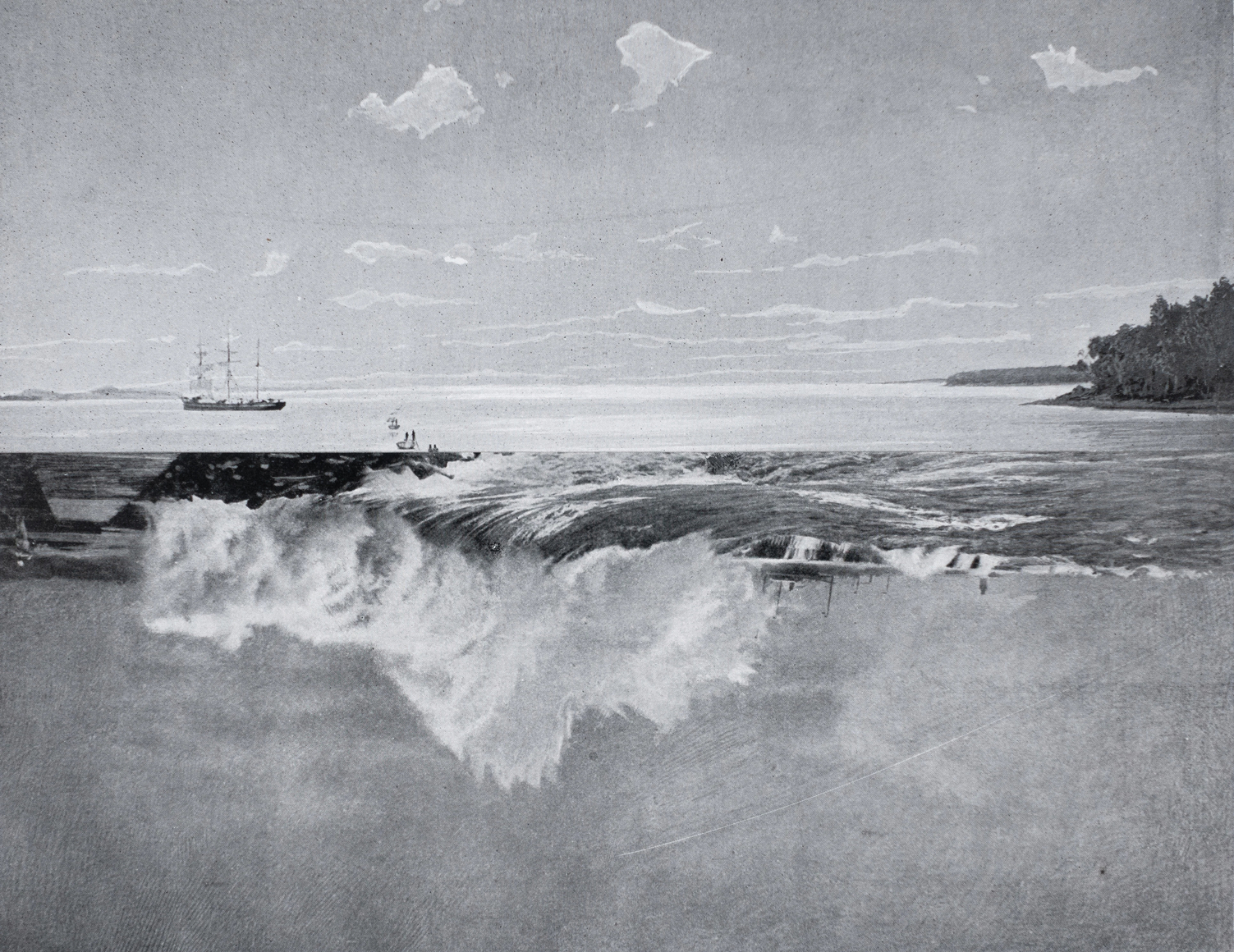
John Stezaker, the British artist known for his groundbreaking conceptual collage cycles, will be having a solo exhibition at GRAY Chicago, opening on March 28, 2026. Titled Raft, the exhibition features a new series of landscape works that mend together two images from the artist’s vast archive to create a single, uncanny composition. Sourced from nineteenth-century British books—ostensibly about world travel, but flaunting the geographic extent of the empire—Raft is a continuation of the radically gestural collage techniques Stezaker has been pursuing for nearly six decades.
Stezaker’s Raft compositions contain what the artist calls “spatial betweens”: oceans and courthouses, rivers and bridges, shipyards and valleys. In their original context, the images were meant to be sublime renderings of pastoral and urban spaces. Sliced in half and placed on top of each other, each of the works centered on a horizontal divide. The artist creates continuity and flow between the two disparate images, resulting in a dynamic perceptual oscillation. As Hope Wolf observes in an essay for the forthcoming exhibition catalogue, the works demand that the audience “seek ways of crossing the divide,” to find the bridge that links the two images. The effect is simultaneously disorienting and pleasurable, revealing parallels and discontinuities between past and present.
Some of the landscapes in Raft are placed upside down, employing a strategy Stezaker developed in 1977—used for a series dubbed the Unassisted Readymades—where found images are simply re-angled in order to surface their inherent strangeness. Pulling from Victorian-era imagery, he calls into question our understandings of this history. As Wolf writes, “Stezaker’s art … conjures mirages of worlds that are irrecoverably lost.” This series of works shows Stezaker's efforts to probe the power that the image maintains, especially in an age of its ceaseless reproduction and distribution. As Stezaker has said, “… collage … is a way of trying to reveal something of the abyss or the hidden void within this continuum of image culture, or the montage of everyday life.”[1]
The work in Raft was inspired by his experience seeing the sky reflected in the “mirror-like wet sands” on the beach in front of his East Sussex studio. The collapsed distinction between above and below elicited sensations of both expansive openness and constrictive enclosure for the artist, a sensation he sought to explore further in the work. A chance encounter with a nineteenth-century photograph of the same stretch of coastline outside his studio further situates Raft within a dialogue between past and present.
Driven equally by intuition and a rigorous theoretical approach, Stezaker’s new body of work echoes the historical and contemporary crises of mass migration and reigniting imperialisms—and yet, they leave interpretation solely up to viewers, allowing them to drift between meanings and thoughts, and forge their own crossings between images, histories, and states of feeling. Stezaker sustains the openness of collage, resisting singular political readings and, as Wolf writes, the impulse to “settle on any one verbal translation of the visual,” while allowing the works to register tensions between retreat and responsibility.
The exhibition opens at GRAY Chicago on Saturday, March 28, with an artist walkthrough at 2:30 PM and a public reception from 3-5 PM. The exhibition will be accompanied by a fully illustrated catalogue designed by HOUR, featuring an essay by art historian Hope Wolf.
ABOUT JOHN STEZAKER
Born in Worcester in 1949, John Stezaker attended the Slade School of Fine Art, where he began working with readymade materials, found images, and collage techniques. Profoundly impacted by London’s vibrant art, theory, and literature scenes of the late 1960s, in 1970, with his friend Victor Burgin, Stezaker started making conceptual work with found photographs that critiqued Conceptual art itself, and began showing with galleries such as Lisson and Whitechapel. Using film stills, publicity photos, postcards, book illustrations, and silkscreens, Stezaker is a unique, outside figure in the constellation of Conceptual art, Pop, Punk, and the Pictures Generation. Stezaker was pioneering similar methods of appropriation, cuts, and rephotography alongside American artists Richard Prince and Sherrie Levine, but one aspect that set him apart was the influence of surrealism on his practice—especially the work of Max Ernst, Georgio de Chirico, and Man Ray—and his approach to sourcing images. Stezaker has said that the images find him.
Stezaker’s years of teaching at Central Saint Martins, Goldsmiths, and Royal College of Art had an indelible influence on subsequent generations, especially the Young British Artists. But it wasn’t until the 2000s that his own work started to become critically reassessed and reappraised. Stezaker has been the subject of solo exhibitions at National Portrait Gallery, Whitechapel Gallery, White Columns, and elsewhere, and was included in the 9th Biennale de Paris and the 19th Biennale of Sydney. In 2012 Stezaker was awarded the Deutsche Börse Photography Prize. His work is held in various collections, including MoMA, New York; Los Angeles County Museum of Art; Stedelijk Museum, Amsterdam; and the Tate, London. John Stezaker lives and works in London and St. Leonards on Sea.
[1] Yuval Etgar, “Imagine That! A Conversation with John Stezaker,” Aesthetic Investigations, Amsterdam, vol.2, no.1, December 2017, p.49, https:// aestheticinvestigat,ions.eu/index.php/ journal/article/view/116.